
Though Peiper had broken through Stavelot, by the next day Stavelot had been retaken by survivors of the 526th and 1st Battalion of the 117th infantry regiment, 30th infantry Division
SS men found themselves trapped in the “Stavelot Pocket.” Men of Gustav Knittel’s reconnaissance group, who had raced through Stavelot to meet Peiper, were ordered to turn around retake Stavelot on December 19th. With Stavelot not in German hands, resupplying Peiper became a major obstacle to the German advance. Peiper would continue on ahead to the west towards Stoumont and La Gleize, Belgium.
The 82nd Airborne in the meantime, had arrived and had been ordered to help the 30th Infantry Division contain Peiper’s breakthrough. While Peiper had successfully broken through, his gasoline/diesel supply was running low.
The 82nd’s 504th, 505th, and 508th Parachute Infantry Regiments, together with the 325th Glider Infantry Regiment and their airborne artillery units, helped establish a defensive line that would prevent the Germans from exploiting the breakthrough or advancing farther west.
The Ambleve Pocket
The Story of Baraque de Fraiture
Near the Belgian village of Fraiture lay Baraque de Fraiture, a vital junction of several major Ardennes highways. The Americans called it Parker's Crossroads, after Major Arthur Parker, who had organized its initial defense on December 19.
As Peiper's advance stalled, the 2nd SS Panzer Division, “Das Reich,” continued its push northward, seeking to break through the American defenses and advance toward the Meuse.
On December 23, elements of Das Reich launched a major assault to seize the crossroads.
An improvised American force, including F Company of the 325th Glider Infantry Regiment, elements of the 509th Parachute Infantry Battalion, artillerymen, and Sherman tanks of the 3rd Armored Division, made a desperate stand.
Two American Shermans fought back against the advancing German armor, knocking out enemy tanks before being destroyed themselves. But Panthers, Panzer IVs, and SS infantry eventually overwhelmed the American perimeter.
Low on ammunition and facing encirclement, the defenders were forced to withdraw. By evening, the crossroads had fallen. Survivors pulled back toward Manhay, carrying their wounded under fire.
Their legendary defense against overwhelming forces added to the numerous example of heroism of the men of the 82nd Airborne
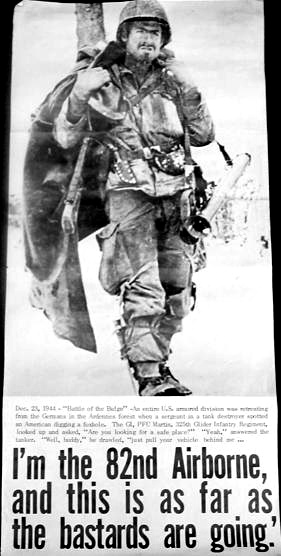
Famously as 325th Glider Infantry regiment men approached the line, PFC Thomas Martin of F company reported said to a armored officer" “Well, buddy, just pull your vehicle behind me. I'm the 82nd Airborne and this is as far as the bastards are going!"
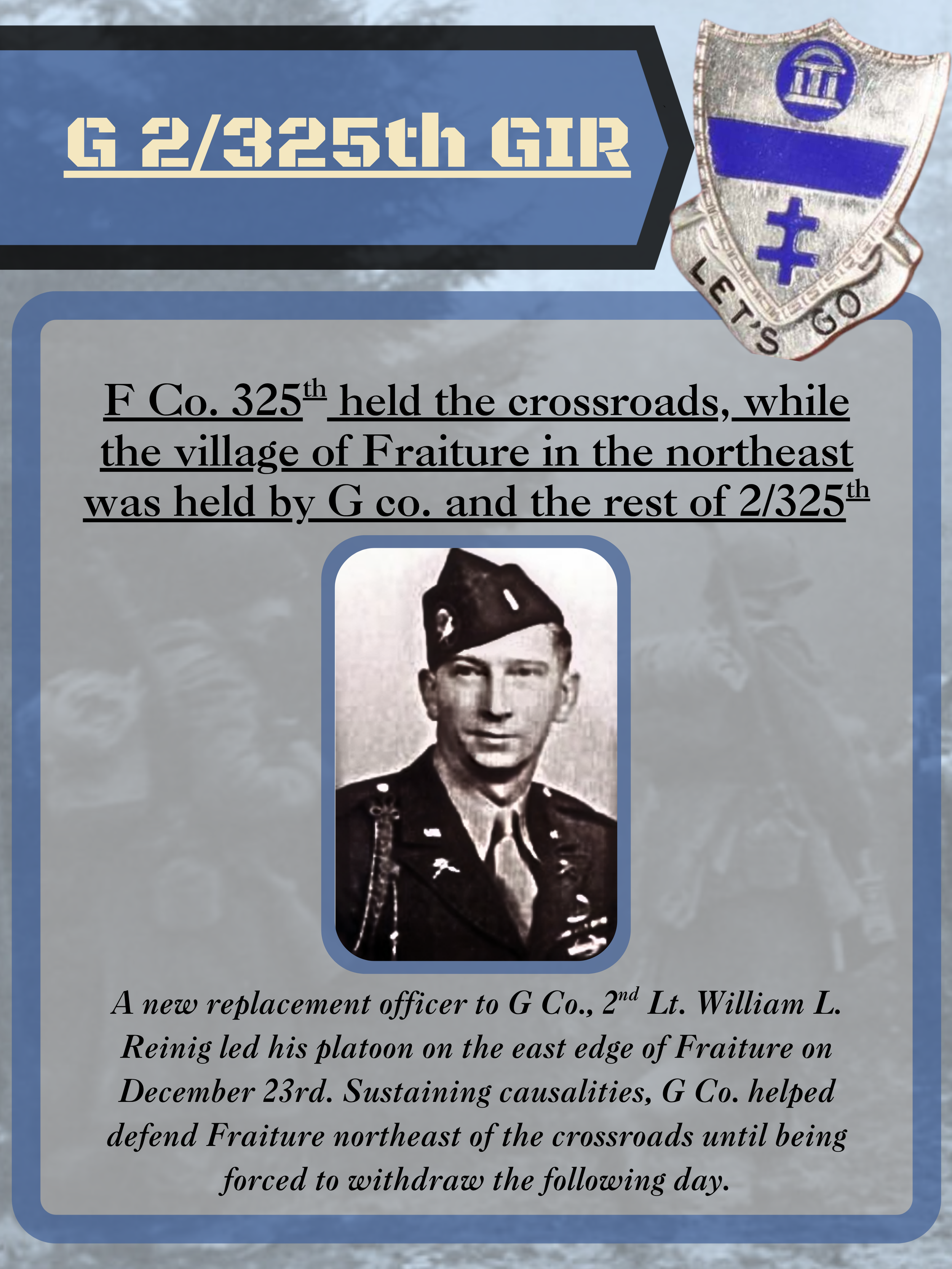
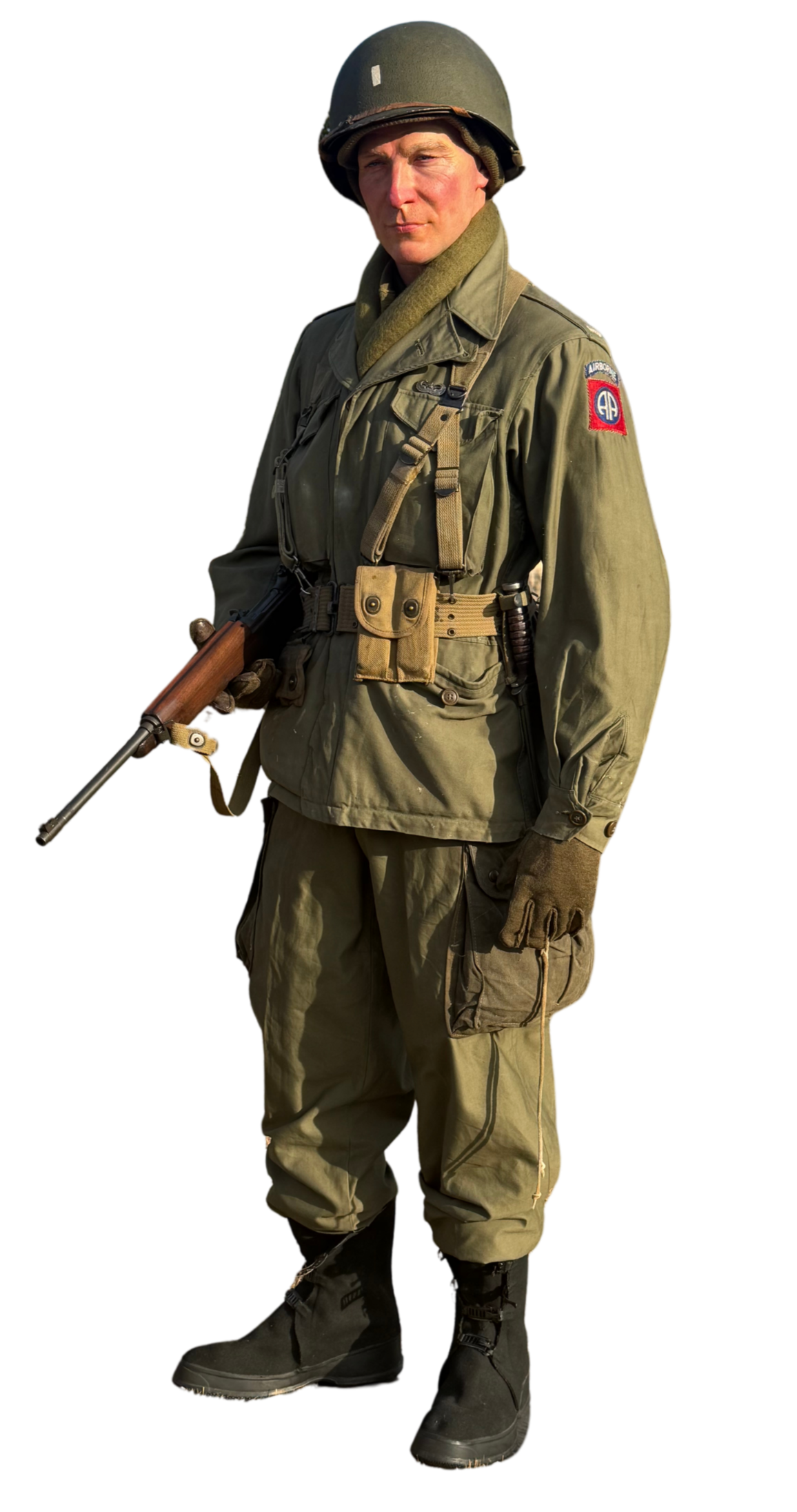
On this mannequin is Lt. William L. Reinig’s M43 field uniform worn in the Northern Shoulder of the Bulge around Fraiture in December 1944
German attempts to reinforce and relieve Peiper continued, but American resistance held. The spearhead that had once raced through the Ardennes was now trapped in the valley, increasingly cut off from the forces behind it.
SS men who failed to retake Stavelot took their violent frustration to the civilian population. Somewhere around 130 - 165 Belgian civilians, many women and very young children, were murdered by the SS in the Stavelot area in December of 1944.
In the early morning hours of December 24, 1944, the remnants of Kampfgruppe Peiper prepared to abandon La Gleize. According to accounts of the withdrawal, “Fröhliche Weihnachten” — “Merry Christmas” — was whispered as signal among the men preparing to escape the encirclement. Though some never received or did not understand the message and were left behind.
Trapped at La Gleize, desperately short of fuel and ammunition, and surrounded by increasingly heavy American pressure, Peiper's men destroyed or abandoned their remaining vehicles. Leaving many of their wounded behind, the surviving SS troops slipped away on foot through the darkness and snow-covered countryside.
They moved eastward toward the Amblève River, where German forces of the 9th SS were still attempting to rescue them. Peiper’s SS men fled east, discarding anything which weighed them down and swam or waded the Ambleve river in the freezing December conditions —desperately trying to make their way back toward the German lines. Of the roughly 5,000 men who had formed the spearhead during its advance, it is estimated that less than 800 returned.